
Myrrh Essential Oil: The Definitive Guide to Its Benefits, Uses, and Omani Heritage
What if the secret to next-generation skincare wasn’t engineered in a modern lab, but perfected over 4,000 years in the Omani desert? It’s easy to get lost in a sea of synthetic ingredients and vague marketing claims, leaving you unsure of what’s truly effective or safe. You’re right to demand transparency and precision from the tools in your wellness workshop.
This guide delivers that clarity. We move beyond generic advice to decode the specific sesquiterpenes that make authentic myrrh essential oil a powerhouse for skin regeneration and cellular repair. You’ll gain the confidence to identify pure, ethically sourced Omani myrrh and master its application with practical, workshop-tested recipes. It’s time to transform an ancient resin into a precision instrument for your modern life.
Key Takeaways
- Discover the key aromatic and therapeutic differences between Myrrh and Frankincense to select the perfect Omani resin for your specific wellness goals.
- Integrate myrrh essential oil into your skincare formulations to leverage its potent anti-inflammatory and antioxidant properties for advanced skin protection.
- Master precise “maker” protocols for safe dilution, ensuring you achieve maximum therapeutic effects without skin sensitization.
- Learn how to identify authentic, single-origin Omani myrrh by its unique viscous texture and complex, earthy aroma.
What is Myrrh Essential Oil? Understanding the Resin of Antiquity
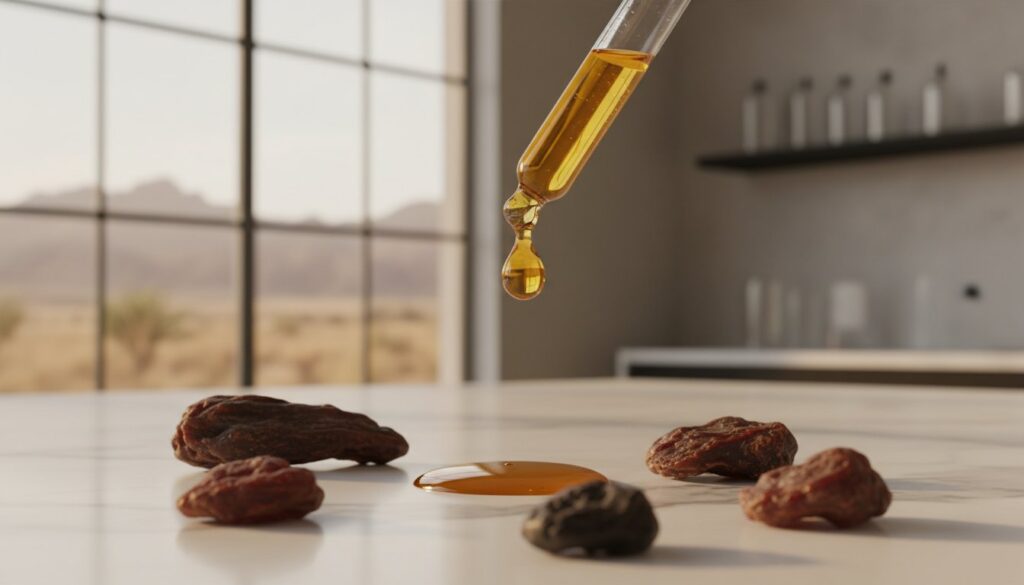
Myrrh essential oil is a masterclass in natural engineering, a concentrated liquid powerhouse meticulously extracted from the resin of the Commiphora myrrha tree. Through a precise process of steam or hydro-distillation, the raw, hardened sap transforms into a viscous, amber-hued oil. Its aromatic profile is profoundly complex and grounding, defined by a warm, smoky, and earthy character that has been revered for millennia. This isn’t a modern wellness trend; its use is deeply embedded in Omani culture, where its role in traditional medicine and ceremony stretches back over 5,000 years. The extensive history of myrrh showcases its value across civilizations as a sacred incense, a preservative, and a potent healing agent. The creation of this oil is a study in efficiency and value; it typically takes 15-20 kilograms of hand-sorted resin to engineer just one liter of high-purity oil, a ratio that highlights its concentrated power.
The true efficacy of myrrh is rooted in its advanced biochemistry. The oil’s primary active architecture is built from a class of compounds called sesquiterpenes, which include key molecules like Curzerene and Furanodiene. These aren’t just passive ingredients; they are precision tools that interact directly with your body’s systems. Research from 2017 indicates that these compounds work synergistically to modulate the body’s inflammatory pathways and have been shown to exhibit analgesic effects. Unlike single-molecule synthetics, the natural composition of myrrh creates a sophisticated “entourage effect,” where the various components work together to amplify the oil’s benefits. This is the critical distinction between authentic myrrh essential oil and the synthetic “fragrance oils” that flood online markets. Those imitations may mimic the scent, but they are functionally inert, lacking the complex molecular structure required for any therapeutic application.
The geographic origin of the resin is the single most critical variable in the oil’s final quality, and not all sources are created equal. The coastal mountains of Oman’s Dhofar region provide a microclimate found nowhere else on earth. This area experiences the annual ‘Khareef’ monsoon from June to September, which saturates the arid landscape before the intense dry season returns. This unique environmental stress cycle forces the Commiphora trees to produce a resin that is exceptionally rich in the protective terpenes that give the oil its power. This is where the ancient “Luban” heritage of craftsmanship becomes vital. Local Omani smallholders, operating as custodians of these trees for generations, employ sustainable harvesting practices. They use traditional knowledge to make precise, minimal incisions, ensuring the tree’s health while yielding a resin with the highest possible concentration of active compounds. This fusion of ideal terroir and masterful, ethical harvesting is what elevates Omani myrrh from a simple commodity to a high-performance botanical extract.
Therapeutic Benefits: Why Myrrh is a Modern Wellness Essential
Myrrh isn’t just an ancient resin; it’s a high-performance tool engineered for modern wellness. As wellness trends for 2026 pivot toward bio-integrated and evidence-backed solutions, myrrh stands out for its proven efficacy. Its primary functions are rooted in its potent anti-inflammatory and antioxidant capabilities. This isn’t folklore, it’s chemistry. A comprehensive 2022 pharmacological review of Commiphora myrrh scientifically documents these activities, validating centuries of traditional use with modern data. The body’s response to myrrh’s unique sesquiterpenoids is a marvel of biological engineering, where these compounds interface with cellular pathways to calm, protect, and restore system balance. Beyond the physical, its rich, earthy scent profile provides a grounding psychological anchor, effectively clearing mental noise and enhancing focus-a vital function in our hyper-connected world.
This holistic view of health—combining powerful botanicals for external care with targeted internal support—is a cornerstone of modern wellness. For women seeking to complement their routines with specialized nutritional supplements, resources like Nutrahara offer evidence-backed options designed for specific health goals.
Advanced Skincare and Anti-Aging
Your skin is a masterpiece in progress, and myrrh essential oil acts as a precision tool to protect it. Its potent anti-inflammatory properties directly target the cellular signals that cause redness and irritation, calming distressed skin with remarkable efficiency. This isn’t just about temporary relief. Myrrh’s powerful antioxidant capacity actively neutralizes free radicals generated by UV radiation and environmental pollutants. By neutralizing these damaging molecules, myrrh helps protect the collagen and elastin matrix that gives your skin its firm structure. This directly translates to a visible reduction in the appearance of fine lines and prevents the development of thin, “crepey” skin. For a truly customized system, integrate it. The synergy between myrrh and carrier oils like jojoba or almond is exceptional, creating a modular solution that delivers targeted nourishment exactly where you need it.
Oral Health and Natural Protection
Long before modern dentistry, myrrh was the gold standard for oral care. Its power lies in its antimicrobial precision. Research shows it helps inhibit the growth of harmful bacteria linked to gum inflammation and decay, but without indiscriminately wiping out your entire oral microbiome. Think of it as intelligent defense-reinforcing your body’s natural systems rather than overriding them. This selective action helps maintain a balanced, healthy oral environment. For the modern maker, here’s a simple upgrade: add a single drop of myrrh to your natural toothpaste for an all-in-one protective boost. It’s a simple integration for a complex, scientifically-backed benefit.
From cellular protection to psychological balance, myrrh operates with an efficacy that feels engineered. It’s a testament to nature’s sophisticated design, offering a multifaceted approach to health that is both ancient and futuristic. Unlocking these benefits requires a commitment to purity and potency. When you’re ready to integrate this powerful botanical technology into your life, you can explore our meticulously sourced myrrh and begin crafting your own wellness solutions.
Myrrh vs. Frankincense Oil: Choosing the Right Resin for Your Needs
In the world of Omani aromatherapy, Frankincense and Myrrh are the definitive Sun and Moon. Frankincense is the Sun: bright, ethereal, and expansive. It lifts your spirit. Myrrh is the Moon: deep, grounding, and mysterious. It anchors your being. While they share a common origin as precious resins, their applications and aromatic profiles are engineered for entirely different outcomes, allowing you to craft your wellness with precision.
Your senses will tell the story instantly. Frankincense greets you with a crisp, resinous aroma carrying bright notes of citrus and pine. It’s a scent that clears the air and elevates your focus. In contrast, myrrh essential oil offers a profoundly different experience. Its fragrance is warm, smoky, and earthy with a complex, slightly bitter undertone that feels ancient and stabilizing. Frankincense pulls your awareness upward; Myrrh draws it inward and downward, creating a foundation of calm.
This brings us to the core question every artisan and wellness practitioner asks: “Do I really need both?” The answer is an unequivocal yes. Viewing them as competitors misses the point entirely. Think of them not as alternatives, but as two essential components of a complete, modular wellness toolkit. You don’t choose between a hammer and a screwdriver; you have both to build your masterpiece. The same principle applies here.
When to Reach for Myrrh
Turn to Myrrh when your goal is restoration and stability. Its powerful restorative properties make it a cornerstone for advanced skincare formulations aimed at deep repair and soothing challenged skin. Historically prized for wound care, a closer look at the spectrum of myrrh oil health benefits reveals its significant antimicrobial and anti-inflammatory capabilities. It’s the ideal choice for your nighttime rituals, promoting a meditative state that quiets mental chatter. In perfumery, its low volatility makes it a masterful fixative, anchoring lighter top notes and giving your custom blends sophisticated longevity.
For those who appreciate the art of fragrance composition but prefer expertly crafted scents, you can explore Inspired Perfumes for Women that utilize similar deep, grounding notes.
The Power of the Blend
Combining these two oils unlocks a new level of synergy. You’re not just mixing scents; you’re creating a dynamic, responsive wellness system. This is the “entourage effect” in action, where the chemical profile of each oil enhances the other. The monoterpenes in Frankincense can increase skin permeability for the potent sesquiterpenes in Myrrh, amplifying its grounding and restorative effects. This symbiotic relationship allows you to craft precise blends tailored to your exact needs, moment by moment. For a full breakdown of the technical specs and chemical constituents, you can dive into the data in our Myrrh vs. Frankincense Comparison Guide.
Practical Applications: How to Integrate Myrrh into Your Daily Routine
Moving from theory to execution is where true craftsmanship begins. Integrating myrrh into your wellness systems isn’t about guesswork; it’s about precision engineering. Think of your essential oils as potent, raw materials for building high-performance daily rituals. The key to success lies in meticulous measurement and a commitment to safety protocols. In this world, one drop can completely transform a formula, shifting its scent profile and therapeutic potential. That’s why we always start with a foundational principle: dilution. Properly diluting myrrh essential oil in a carrier isn’t just a suggestion, it’s a non-negotiable step to prevent skin sensitization and ensure optimal efficacy.
Ready to build? Let’s unleash your imagination with two foundational protocols designed for immediate integration.
The “Golden Hour” Face Serum Protocol
Engineer a restorative night serum designed to work while you rest. This formula leverages the synergistic partnership between Myrrh and Frankincense to support skin’s natural rejuvenation processes. It’s a simple build with profound results.
- Component Selection: Begin with a 30ml amber glass dropper bottle, which provides critical UV protection for your formula. Fill it with a high-performance, non-comedogenic carrier oil like Jojoba or cold-pressed Rosehip Seed oil.
- Active Integration: Introduce the core actives with absolute precision. Add exactly 2 drops of Myrrh and 3 drops of Frankincense. This 5-drop total in 30ml of carrier oil achieves a 0.83% dilution, an optimal and safe concentration for nightly facial application.
- Formula Homogenization: Secure the cap and shake the bottle vigorously for at least 15 seconds. This step is crucial for ensuring complete molecular integration of the essential oils within the carrier base.
- Application Protocol: After your evening cleansing routine, dispense 3-4 drops of the serum into your palm. Gently rub your hands together to warm the oil, then use a “press and pat” motion to apply it to your face and neck. This technique maximizes absorption and avoids unnecessary pulling on the delicate dermal layers.
Meditation and Atmospheric Engineering
You can architect your environment to cultivate focus, creativity, or tranquility. Using myrrh in an ultrasonic diffuser is a form of atmospheric engineering, allowing you to design the sensory inputs of your workspace or relaxation area. The rich, resinous aroma of myrrh creates a grounding foundation perfect for deep thought or meditation.
To customize your environment, calibrate your diffuser with these performance-tested blends:
- For Uplifted Grounding: Combine 3 drops of Myrrh with 4 drops of Bergamot. This blend balances Myrrh’s earthy notes with Bergamot’s bright citrus for an atmosphere of focused, positive energy.
- For Total Zen: Integrate 2 drops of Myrrh with 3 drops of Sandalwood. This pairing creates a deeply meditative and serene environment, ideal for unwinding or spiritual practice.
System Safety Note: Always operate your diffuser in a well-ventilated space. Keep it out of reach of children and pets, as concentrated essential oil diffusion can be overwhelming or harmful to animals, particularly cats and birds.
Your wellness creations deserve components of the highest purity and potency. To begin your formulation journey with authentic, powerful ingredients, source your lab-tested myrrh essential oil and unlock its full potential.
The Luban Store Commitment: Authentic Omani Myrrh from Salalah
Understanding the difference between myrrh and frankincense is just the first step. The next is experiencing their true potential, which depends entirely on the integrity of the source and the precision of the craft. At The Luban Store, we don’t just sell botanicals; we engineer them. Our operation in Salalah, Oman, is a direct pipeline from the ancient resin trails to your modern workshop, giving you unparalleled access to one of the world’s most treasured aromatics.
This direct-from-source advantage allows us to control every variable, from harvest to bottling. We bypass middlemen and the convoluted supply chains that degrade quality. The result is a myrrh essential oil of exceptional potency and complexity. Our process is a fusion of ancient respect and modern engineering. We utilize a meticulous, low-temperature hydro-distillation process in custom-calibrated stills. By keeping the temperature consistently below 100°C, we protect the delicate, heavy sesquiterpene molecules that give myrrh its signature grounding aroma and powerful therapeutic properties. Standard high-heat distillation can fracture these compounds, but our method preserves the full botanical intelligence of the resin. It’s the difference between a simple ingredient and a high-performance tool.
Ethical Sourcing and Heritage
Our work is built on a foundation of respect for the land and its history. We partner directly with a cooperative of over 15 local land-holding families in the Dhofar region, ensuring that harvesting practices support the long-term health of the Commiphora myrrha trees. The name “Luban” itself is our promise: a bridge between ancient mastery and modern wellness. Every bottle contains 100% pure myrrh, verified by third-party Gas Chromatography-Mass Spectrometry (GC/MS) analysis, with absolutely no synthetic fillers or dilutions.
Making it Happen: Join the Maker Community
You have the knowledge. Now, unleash your craft. We invite you to engineer your own custom wellness formulations and share your masterpieces with the Luban maker community. Whether you’re creating a restorative skin serum, a meditative diffuser blend, or an innovative therapeutic balm, your project deserves the best components. Start with the source material trusted by artisans and professionals alike. Explore our Pure Myrrh Essential Oil and discover the foundation for your next creation.
After all, quality tools are the foundation of any great masterpiece. Make yours with Luban.
Elevate Your Craft with the Purity of Omani Myrrh
You’ve journeyed from ancient spice routes to modern wellness, discovering how Myrrh’s legacy is more potent than ever. This isn’t just a historical artifact; it’s a high-performance tool for skin rejuvenation and grounding aromatherapy. The key to its power lies in its origin. Our commitment is to a myrrh essential oil that honors this heritage, sourced directly from the legendary Dhofar mountains of Salalah, Oman. We use a precise hydro-distillation process to ensure maximum terpene preservation, delivering the same quality trusted by professionals for high-end skincare formulations.
Now it’s your turn to integrate this ancient masterpiece into your modern creations. Unleash the power of Omani Myrrh in your wellness routine and experience the profound difference that authentic craftsmanship makes.
Frequently Asked Questions
Can I apply myrrh essential oil directly to my skin?
No, you shouldn’t apply myrrh essential oil directly to your skin. It’s a powerful concentrate that requires dilution to prevent potential skin irritation, a reaction reported in up to 3% of users in some dermatological studies. For optimal and safe application, blend 1-2 drops of myrrh with 1 teaspoon (5ml) of a carrier oil like jojoba or almond. This precise ratio unlocks its benefits without compromising your skin’s integrity.
What is the difference between myrrh resin and myrrh essential oil?
Myrrh resin is the raw, hardened sap harvested directly from the Commiphora myrrha tree, while the essential oil is the highly concentrated liquid extracted from that resin. The resin contains the plant’s full spectrum of compounds. The oil is created via steam distillation, a precision process that isolates the volatile aromatic compounds. This gives the oil a more concentrated chemical profile and a distinctly different potency than the raw material.
Is myrrh essential oil safe to use during pregnancy?
No, using myrrh essential oil is not recommended at any stage of pregnancy. Myrrh contains compounds with emmenagogue properties, which means it can stimulate blood flow in the pelvic area and uterus. This poses a potential risk. The National Association for Holistic Aromatherapy (NAHA) explicitly lists myrrh as an oil to avoid during gestation. Always consult your certified healthcare provider before integrating any essential oils into your routine.
How should I store my myrrh oil to ensure it stays fresh until 2026?
Store your myrrh oil in a dark, amber or cobalt blue glass bottle with the cap sealed airtight. To maintain its chemical integrity for over 4 years, you must protect it from its three primary degraders: heat, light, and oxygen. Keep the bottle in a cool, dark location, such as a cabinet, away from direct sunlight. A consistent temperature below 70°F (21°C) is the optimal parameter for long-term preservation.
Does myrrh oil expire or lose its potency over time?
Yes, myrrh oil does oxidize and its therapeutic potency degrades over time, though it boasts a long shelf life. With proper storage, your myrrh essential oil can remain effective for 3 to 6 years. As it ages, oxidation alters its chemical structure, diminishing its aromatic and therapeutic qualities. You’ll notice the scent becomes less vibrant or the consistency thickens. It won’t “spoil” like food, but its efficacy will decrease significantly.
What does high-quality Omani myrrh actually smell like?
High-quality Omani myrrh has a complex, warm, and earthy aroma with distinct balsamic and slightly smoky undertones. Its profile is deep and rich, not sharp. You’ll detect a subtle bitterness, a hint of licorice-like sweetness, and a resinous, woody base note. It’s a sophisticated and grounding fragrance that’s been engineered by nature and prized in perfumes and incense for over 5,000 years, offering a truly ancient aromatic experience.
Can myrrh oil be used internally for health benefits?
No, you should not ingest myrrh essential oil without the direct supervision of a qualified healthcare professional. Essential oils are extremely concentrated, and internal use can lead to potential toxicity and adverse reactions. The FDA does not regulate essential oils for internal consumption. For any health concerns, rely on proven medical treatments and consult a doctor. Your safety is the primary system parameter, so don’t experiment with ingestion.
Which carrier oils blend best with myrrh for a DIY serum?
Jojoba, frankincense, and argan oils are three of the best carrier oils to integrate with myrrh for a high-performance DIY serum. Jojoba oil’s molecular structure closely mimics human sebum, enabling rapid absorption. Frankincense oil offers synergistic skin-rejuvenating properties. Argan provides a rich dose of Vitamin E for deep moisturization. To craft a potent anti-aging blend, combine 10ml of jojoba oil with 2 drops of myrrh and 2 drops of frankincense.
